Remember when businesses used only billboards, TV ads, or newspaper ads to market to customers? Those are ancient times, my friend. We are living in a world where a tweet from a social media user can make or break a company, and a strategic Instagram post can lead to millions of dollars in revenue for a business. Though this wasn’t an instantaneous event, it has changed everything about business interactions.
The development and use of digital marketing as a tool have created a new revolution in business, beyond anything that we may have envisaged just two decades ago. From simple email campaign tools and websites, digital marketing has grown to a whole new dimension of business success in every field of commercial activity.
In this comprehensive guide, we’ll take you on a fascinating journey through the evolution of digital marketing, delve into why it has become an essential tool for today’s business world, and reveal to you some of the ways you can utilize its power. You might be a new small business owner or a large company looking to improve your strategy. Either way, learning about this emergence is crucial for your success.
What is Digital Marketing?
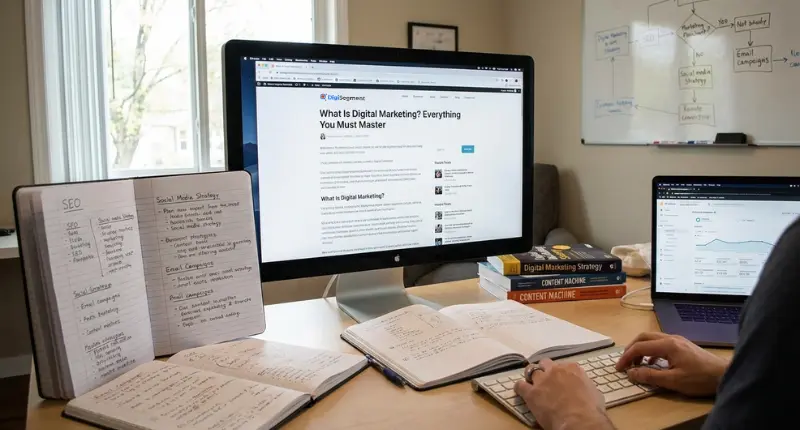
Essentially, digital marketing is any marketing activity that, in whole or in part, relies upon digital devices or internet communication. Companies work to connect with customers and even potential customers through digital channels such as search engines, social media, emails, and websites. However, digital marketing goes far beyond advertising.
Think of it as having a conversation with your customers where they are—you know, while they are scrolling through Facebook during their morning cup of coffee, searching Google to solve the problems they’re trying to solve, or watching YouTube videos before bed. Digital marketing connects with people at these moments and delivers value, fosters relationships, and supports business growth.
At Digi Segment, we’ve seen this model in action and the impact it has on a business because, quite frankly, it’s not about interrupting people with ads they don’t want. It’s about being present and helpful when the customer needs what you’re providing.
The Traditional Marketing vs Digital Marketing Shift
The classic approach to marketing had its inherent beauty, and, of course, yes, it still exists. However, to be honest, it was expensive, difficult to measure, and sometimes like shooting an arrow in the dark. We would spend thousands on a billboard and hope the right person would read it, run a television commercial and hope the right person would be watching the television set.
But digital marketing changed everything for us. Now, markets could be targeted like never before! Clicks, conversions, and dollars could be tracked! And perhaps most relevant of all, markets could be adapted to in real-time depending on what worked—and what didn’t!
The change was not just in terms of the tools used; it was also in terms of the interaction of businesses with customers. Conventional marketing was one-way traffic; businesses spoke, and customers listened. Digital marketing offered a two-way conversation in which responses are immediate, yet relationships are long-term.
Why Digital Marketing Matters in Today's Business Landscape
The truth of the matter is this: your customers are online. All of them. The latest numbers show that more than 5 billion people worldwide are online and actively making purchasing decisions.
If you are not a part of that dialogue, you are literally invisible. It is not just about participating inside this ecosystem. Digital marketing is important because it equalizes the field. A small business startup with a good strategy has equal opportunity to compete against the titans of the industry. A local business has the potential to access a global audience. People who run businesses from their kitchen table have the opportunity to create a million-dollar brand.
The rise of digital marketing as a tool for that purpose has democratized success like nothing else ever has. It’s given voice to the voiceless and opportunity to people who might never have had it otherwise.
The Historical Timeline of Digital Marketing
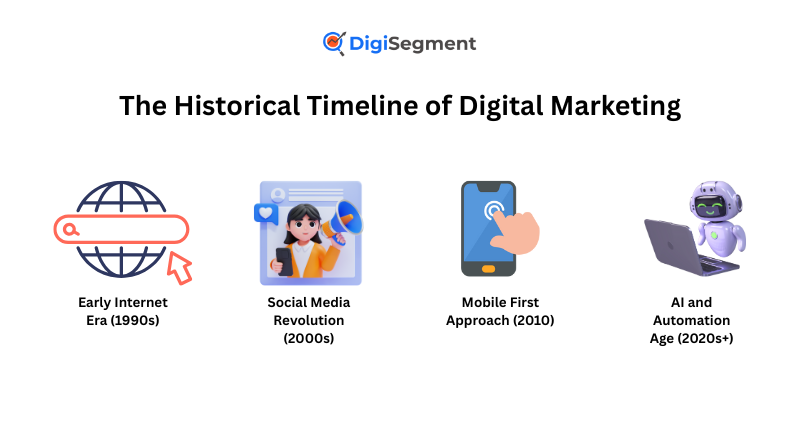
Early Internet Era (1990s)
The 1990s were wild. The internet was new, clunky, and most people didn’t quite know what to do with it. The websites looked awful by today’s standards, but they were revolutionary. Business started making simple websites, and email marketing started happening.
Search engines such as Yahoo and, of course, soon after, Google, entered the scene. Banner ads arrived, which are, frankly, the obnoxious rectangles we all became skilled at blithely ignoring. Even though all of this is rather primitive, it is building the groundwork for something rather ground breaking.
Social Media Revolution (2000s)
And then there was the 2000s. Everything exploded. Facebook was founded in 2004, YouTube in 2005, Twitter in 2006. Suddenly, businesses had a way to directly connect with their customers, and all of this changed.
Social media marketing wasn’t even a recognized profession five years ago. By the end of the decade, companies were hiring teams of people to manage their social presence. This is when digital marketing as a tool really emerged because finally, companies could have a real conversation with their consumers.
Mobile First Approach (2010)
Smartphones: The Revolutionary Era. Everything changed. Again. By 2010, more people used their phones to access the internet than used their computers. This forced businesses to rethink their whole digital strategy.
- Responsive design was now a necessity.
- Apps became marketing channels.
- Mobile advertising grew exponentially.
HV Digital Marketing was founded largely due to the complexities of this environment for businesses.
AI and Automation Age (2020s+)
Welcome to now. We are living in a world in which artificial intelligence predicts consumer actions, chatbots manage consumer services, and marketing automation systems manage advanced advertising campaigns while you sleep. These tools are as futuristic as science fiction from just a decade ago.
Machine learning algorithms can optimize ad spend in real-time. Predictive analytics enable us to know what our customers want before they even realize it themselves. But personalization has reached a point where every customer can have a unique experience with your brand.
Key Factors Driving the Emergence of Digital Marketing
Technological Advancements
Not only has technology given us the ability to have digital marketing, but it has propelled this practice forward. Technological advancements have given us increasingly better internet speeds, devices, and software that have enabled us not only to practice digital marketing but to do so effectively.
Thanks to cloud computing, small businesses gained access to powerful tools that are usually reserved for larger businesses. Data storage became affordable enough so that every interaction could be tracked. Also, platforms were created that allow people to automate tasks that used to require a team of people.
Consumer Behavior Changes
People also changed. Modern consumers research before purchasing a product. They read reviews, compare different products, and follow recommendations from others. People also require brands to understand them.
This altered form of marketing necessitated the use of digital marketing, as traditional marketing did not fulfill this requirement. You can’t create a TV commercial targeting individual customers, but you can certainly customize an email or a website.
Cost-Effectiveness and ROI
Let’s talk money. Conventional marketing was extremely expensive for businesses to adopt. A full-page advertisement in a magazine could run businesses into the tens of thousands of dollars. A TV commercial? Forget it unless your company had a massive budget for it.
Those barriers have been broken by digital marketing. You can conduct an effective social media campaign for a few hundred dollars. Email marketing costs a few pennies a message. And the best part is, you know exactly what you get for what you invest and whether it is a return or not.
Global Reach and Accessibility
“For example, geography was once a limitation for businesses. This means that if you had a business located in a small town, your market was limited to that small town.” Digital marketing has erased those boundaries completely.
Now, a boutique in Iowa can sell its goods in Tokyo. Similarly, a consultant in Bangalore can have clients in New York. The entire world as a market became a possibility just because the world of digital marketing came into existence – and that is absolutely revolutionary.
Core Components of Digital Marketing as a Tool
Search Engine Optimization (SEO)
SEO is the art and science of ensuring that your website ranks higher in search results. So if someone wants to know “the best coffee shops near me” or “how to fix a leaky faucet,” you want your business to show up at the top for one or both of those searches.
Importance of Organic Visibility
Organic Visibility—Showing up on Search Engines without Running Paid Ads
Organic visibility is very important in building trust and credibility. People are more likely to trust and click on organic results rather than on paid ads.
In addition, organic traffic does not have costs because it is free. After establishing a strong presence on search engines, natural traffic will be generated without having to pay for every click on your site. That is powerful because of compounding.
On-Page and Off-Page SEO Strategies
On-page SEO refers to the process of optimizing the content, structure, and technology of a website. This encompasses content optimization, keyword usage, quality content development, image optimization, and high-speed loading of web content.
Off-page SEO is all about building your website’s authority, which means getting backlinks, social media, etc. When another website or websites link to your website, it’s a vote of confidence.
Content Marketing
Content
Content marketing is focused on providing valuable content that will attract your audience or readers. You will be providing them with useful information instead of advertising your products.
Creating Valuable Content
The important word here is “valuable.” This means that the information you create actually helps people. Answer their questions. Solve their problems. Teach them something new. When you do this, you become an authority in the field.
Storytelling and Brand Building
Because humans are wired to respond to stories, you can be assured that your audience can remember a story better than facts and figures. Use storytelling to make your brand more memorable.
Share customer stories. Share the story of how your business got started. People like the human side of business. People relate better to a business when they see the human touch.
Social Media Marketing
Social media is the place where the conversation takes place. It is where your customers spend their hours every day, and that is why your brand must be there.
Platform Selection Strategy
You don’t have to dominate every platform. It is advised that trying to succeed in every single space will cause substandard performance in every space. You should rather aim to succeed in locations where your target consumers spend their time.
Companies serving the B2B space might also consider LinkedIn. Visual-based brands will benefit from Instagram. News-based information can be disseminated through Twitter. Consider what will have the greatest impact first.
Engagement and Community Building
Social media is not just a medium for broadcasting; it’s a dialogue. Participate in comments. And always Ask a questions. Make content that deeply conversation. Make a social community for your brand so people feel like they belong to something bigger than themselves and belive on it.
Email Marketing
Email marketing is among the most effective avenues in digital marketing with a high ROI. Despite predictions that email marketing is dead, it is an incredibly effective tactic that is personal, direct, and owned.
Personalization Tactics
Personalize your newsletters – generic mass emails don’t work anymore. Use your subscriber’s names. Segment your list according to subscriber behavior. Send relevant content that matches where they are in the lifecycle.
Personalization greatly increases open rates, click-through rates, and conversions as humans respond to communications that they feel are individualized.
Automation and Segmentation
Through marketing automation, you can send the right message to the right person at the right time without any intervention. This way, you can set up welcome emails to new subscribers, send reminders on abandoned carts, and more.
Segmentation ensures that different groups receive content that meets their specific needs and interests, thus making your campaigns more effective.
Pay-Per-Click Advertising
PPC advertising allows you to pay for people to come to your site, rather than earning it naturally. With PPC, you create an ad, bid on keywords, and pay when people click on it.
Google Ads and Display Networks
Google Ads enables you to put your business in front of people who are actively searching for what you’re offering. If someone is searching for “emergency plumber,” you can be right at the top of the page.
Display networks show your ads across millions of websites, increasing brand awareness and allowing you to reach people even when they don’t explicitly search for anything.
Retargeting Campaign
Retargeting targets individuals after they’ve visited your website previously. It is a very effective way of re-engaging visitors with your site, as they have previously shown some interest in your product and are therefore more likely to convert when you target them a second time.
Analytics and Data-Driven Marketing
Measuring Performance Metrics
Digital marketing’s secret power is that everything can be measured. Website traffic, time spent on a page, conversion rates, customer acquisition costs, lifetime value – everything can be quantified.
Data will also tell you exactly what’s working and what’s not so you can make informed decisions rather than guessing.
Conversion Tracking and Optimization
Conversions—i.e., sales, sign-ups, phone calls—help you identify what’s really working for your business. After that, you can optimize ads for even more of these powerful activities.
Benefits of Digital Marketing as a Business Tool uses
Increase Brand Visibility and Awareness
Digital marketing allows you to reach millions of potential customers for your brand. You can reach people who may not even know your existence through search engines, social media sites, content marketing, or paid advertisements.
Targeted Audience Reach
Demographic and Psychographic Targeting
Target people based on age, gender, income, education, interest, behavior, values, and lifestyle. This is going to pinpoint your message to the people who need it and who care.
Geographic and Behavioral Segmentation
Target specific geographic locations—countries, neighborhoods, etc. Target individuals based on past behavior, purchase history, and online activities. It was never possible for marketers to do this level of micro-targeting in traditional marketing.
Cost-Effective Marketing Solutions
Budget Flexibility for Small Businesses
Starting from $50 and increasing according to your results. Digital marketing can be scaled according to budgets of all sizes.
Higher ROI Compared to Traditional Methods
ROI with digital marketing tends to be much better than with other marketing methods because it’s more directed, measurable, and malleable. You’re not throwing money away trying to market to the unconvertible.
Measurable Results and Real-Time Analytics
See results in real-time. Instantly know if something is working or not. Make on-the-fly strategic decisions based on real data rather than gut feelings.
Improved Customer Engagement and Retention
Digital channels give you the ability to stay connected with customers long after the initial sale. Share helpful information. Provide exclusive offers. Request feedback. Building such relationships can turn a one-time consumer into a customer for life.
Competitive Advantage in the Digital Age
Those businesses that effectively utilize digital marketing also have an advantage over others which do not. You will be able to respond to changes more quickly, understand your customers more, and modify your products accordingly.
Conclusion: Embracing Digital Marketing for Sustainable Success
Digital marketing as a tool has significantly changed the way business is conducted. It is not just an option; it has become a necessity in the modern business world.
Well, we have embarked on a journey through the history of digital marketing, from the clunky websites of the 1990s to the sophisticated AI-driven marketing campaigns of today. We have learned about the main parts that make digital marketing function and the tremendous benefits it can bring to different businesses.
The problem here is while one should be aware of digital marketing, execution of the same is a different ballgame altogether. For one thing, the environment is constantly evolving; there are new technologies coming up all the time, for example.
That’s why professionals exist. Perhaps you’ll turn to companies like Digi Segment and HV Digital Marketing, or assemble a staff of digital marketer types. Investing in professionals is a smart move.
Those are the businesses that are thriving today: not those that have the largest budgets or the greatest legacy, but those that understand digital marketing best. Those are the businesses that are connecting with consumers at relevant touchpoints, providing utility, establishing relationships, and embracing evolution.
What is your next step, then? Well, you need to begin somewhere. You need to find one of these channels and master it. Make valuable content. Connect with your audience. The emergence of digital marketing as an instrument has given us opportunities that have never existed before. Not that these opportunities are available to just anyone.
The question is not whether or not you should participate in this digital revolution, it is how quickly can you get started, how quickly can you execute. Your future success depends on that.
Frequently Asked Questions (FAQs)
The emergence of digital marketing as a tool describes the development and usage of online marketing techniques that businesses are using to acquire and engage with customers via the internet. This marks a significant shift from conventional marketing to precise digital marketing avenues like social media marketing, email marketing, content marketing, and the like.
Digital marketing was made indispensable because the behavior of consumers was seen to have shifted into the digital space, with billions of people researching and purchasing products online. Additionally, the cutting-edge feature of digital marketing, which allows for precise audience targeting and an increased ROI for a reduced cost, made digital marketing indispensable for any business looking to stay afloat.
This includes the cost-effectiveness, specificity of targeting the market niche, real-time tracking, and an ability to go global, all of which are not achievable with conventional marketing. This is because, unlike the billboard and television mediums, with digital marketing, the marketing plan can be altered on the spot and can be scaled up on any budget.
Social media marketing and email marketing usually represent the best entry points for small businesses because they represent a cost-effective, easy-to-learn form of marketing with considerable results for a low cost of entry. As a combined solution with local SEO and Google My Business optimization, small businesses can utilize all these tools with ease and compete favorably without a massive budget.
For instance, the cost of digital marketing can vary from as little as $500 per month for small-scale marketing campaigns up to $10,000 or more for digital marketing strategies. Nevertheless, the uniqueness of digital marketing is that one can start with small-scale marketing, such as organic marketing via social media and SEO, and increase the scale via paid advertising once results are realized.
Yes, it is absolutely possible to step into digital marketing without any technical knowledge because there are various platforms such as Facebook, Instagram, and email marketing tools, etc., that are designed in such an intuitive way that anyone can easily use them. Still, if you are planning to move into more sophisticated strategies such as “SEO Optimization,” “Marketing Automation,” etc., it is always best advised to partner with digital marketing agencies such as Digi Segment and HV Digital Marketing.
The common period for SEO and organic marketing is between 3-6 months before data is seen, while for paid advertising campaigns, you may receive leads and products in days or weeks after the campaigns went live. The specific amount of time may vary depending on your industry, budget, and the level of competition; however, the more consistent you get, the more your digital marketing compounds.

I’m Hardik Vaghani, founder of HV Digital Marketing, a results-driven digital marketing agency. I specialise in SEO, Google Ads, and social media marketing, helping businesses grow their online presence with proven strategies. I’m passionate about creating high-quality, SEO-optimised blogs that educate readers and rank on Google. My goal is to turn ideas into measurable digital success through smart, ethical marketing.