A client came to me last year convinced her Facebook Ads budget was money down the drain. Three weeks, decent spend, almost no sales. Turned out the ads weren’t the problem. Her product needed people who were already searching for it, not scrolling past it, and that meant Google Ads Search would’ve done the job her Meta campaign never could. I’m Hardik Vaghani, founder of Digi Segment and HV Digital Marketing in Surat, and I hold Google’s own Ads Search Certification. The Facebook Ads vs Google Ads question is the one I get asked more than almost anything else by small business owners deciding where their first ad rupee should go.
Here’s the Short Answer
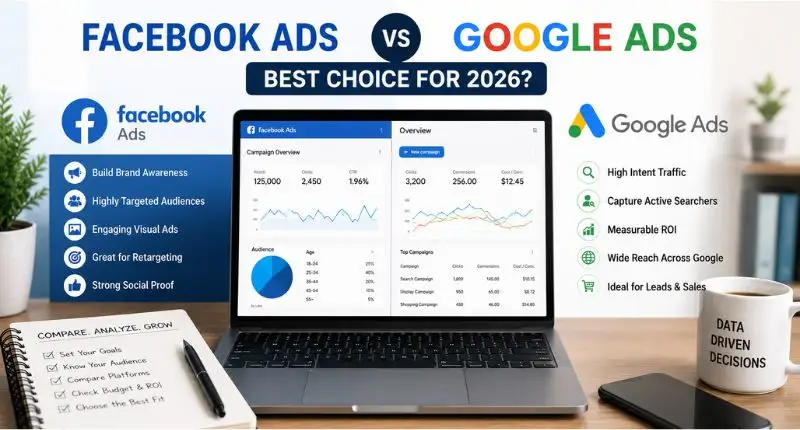
Google Ads works when people are already searching for what you sell, think “AC repair near me” or “best CRM for small teams.” Facebook Ads (running through Meta Ads Manager) works when you need to create demand among people who weren’t looking yet but fit your ideal customer profile. Choosing between Facebook Ads vs Google Ads usually isn’t an either-or decision. It’s about matching the platform to where your buyer actually is in their journey.
Most business owners never frame it that way, though. They read one blog calling Google Ads “too expensive,” another calling Facebook Ads “dead in 2026,” and they end up freezing for another quarter while a competitor runs both. Search for Facebook Ads vs Google Ads and you’ll find dozens of generic listicles recycling the same five bullet points. None of them ask the actual question: which platform matches how your specific customer buys?
Facebook Ads vs Google Ads: Key Differences at a Glance
At the core, the two platforms solve different problems. Google Ads captures demand that already exists. Someone types “solar panel installer Surat” into the search bar and your ad shows up right when they’re ready to act. Facebook Ads creates demand. It puts your offer in front of someone scrolling their feed who wasn’t thinking about solar panels five seconds ago, but fits the exact profile of someone who’d want them.
Here’s a side-by-side breakdown scored on a simple 1-5 scale, based on what I see running both for clients across e-commerce, real estate, healthcare, home improvement, and solar:
| Factor | Google Ads | Facebook Ads |
|---|---|---|
| Budget-friendliness | 3/5 | 4/5 |
| Targeting precision | 4/5 | 5/5 |
| Buyer intent | 5/5 | 2/5 |
| Ease of use for beginners | 3/5 | 4/5 |
| Speed to first result | 4/5 | 3/5 |
| Best for cold audiences | 2/5 | 5/5 |
That table alone won’t decide anything for you. But it’s a useful gut check before you spend a single rupee.
How Audience Targeting Works on Each Platform
Google Ads targeting starts with keywords, not people. You’re bidding on what someone typed into the search bar, and the platform shows your ad based on that query’s intent. There’s no interest-based layer sitting underneath it on Search campaigns, which is exactly why the clicks tend to be more expensive but convert at a higher rate.
Facebook Ads targeting flips that entirely. You’re not targeting a search term. You’re targeting a person, built from demographics, interests, past behavior, and lookalike audiences pulled from your existing customers. Want to reach women aged 28-40 in Ahmedabad who follow interior design pages and recently engaged with home renovation content? Facebook Ads can build that audience in about ten minutes. Google Ads simply isn’t built for that kind of layered targeting on Search.
This is really the heart of the Google Ads vs Facebook Ads targeting debate. One waits for intent to show up. The other manufactures the opportunity before intent exists.
Cost Comparison: CPC, CPM, and Overall Ad Spend
Numbers matter more than opinions here, so let’s use real 2026 figures. According to WordStream’s 2026 benchmark report covering over 13,000 search campaigns across 23 industries, the average cost per click across Google Ads sits at $5.42. Compare that against Foundry CRO’s 2026 industry data showing Facebook Ads averaging $1.72 per click, with plenty of variation by sector.
That gap looks like an easy win for Facebook Ads vs Google Ads on cost alone. But cheap clicks aren’t the goal, qualified clicks are. Google’s higher CPC usually buys traffic that’s already decided to buy something similar to what you sell. Facebook’s cheaper CPC buys attention from people who might convert, might not, and often need three or four touches before they do.
I generally tell clients with a first-time budget under ₹25,000 a month to test Facebook Ads first, purely because the learning cost per click is lower and mistakes hurt less. Once you know your offer converts, Google Ads Search becomes the platform where you scale that proven offer against people who are already halfway to buying.
Intent-Based Advertising: Google vs Interruption-Based Advertising: Facebook
This distinction matters more than any cost chart. Google Ads is intent-based advertising. It shows up in response to a question someone already asked. Facebook Ads is interruption-based, it shows up while someone is doing something else entirely, and asks them to stop and pay attention.
Neither approach is “better” in the abstract. A dentist running same-day appointment ads wants intent-based advertising, because someone in pain right now is going to search, not scroll. A new skincare brand nobody’s heard of needs interruption-based reach first, because there’s no search volume yet for a product that doesn’t have brand awareness.
Honestly, I think a lot of agencies oversell interruption-based advertising to clients who actually need intent capture first. If your business solves an urgent, already-recognized problem (plumbing, legal help, emergency repairs), lean Google. If you’re introducing something new, a product category, a lifestyle brand, a subscription box, Facebook usually earns its budget first.
What Actually Happened When We Tested Both for a Real Estate Client
In early 2025, a real estate client came to us with a ₹35,000 monthly ad budget and a firm belief that Facebook Ads was the only serious option for property marketing. Visual listings, drone footage, the whole pitch made sense on paper.
We ran Facebook Ads alone for the first six weeks. Cost per lead landed around ₹1,850, which wasn’t terrible, but only 2 of the first 40 leads booked a site visit. Most were curious scrollers, not buyers. So we shifted 60% of the budget into Google Ads Search targeting high-intent terms like “3BHK flats for sale in Vesu.”
Cost per lead rose slightly to about ₹2,100. But site visit conversion jumped to 9 out of 25 leads. Fewer, pricier leads that actually showed up beat more, cheaper leads that never did. We kept a smaller Facebook budget running purely for retargeting people who’d already visited the site once through Google.
I’ll admit I underestimated how much Facebook’s cheaper leads would drag down the visit rate. It’s a mistake I don’t make with real estate clients anymore.
Which Platform Works Best for Different Business Types
The right answer changes by industry, and generic advice tends to ignore that.
E-commerce: Facebook Ads usually wins for cold-traffic product discovery, especially with visually strong products. Google Shopping campaigns then pick up the people who already know your brand and are ready to compare prices.
Real estate: A blend works best, Facebook for listing visibility and retargeting, Google Search for capturing people actively hunting for a specific property type or area.
Healthcare: Google Ads tends to be more straightforward here because compliance rules around health claims are easier to manage on search intent than on interest-based feeds.
Home improvement and solar: Search wins for urgent or high-consideration purchases like AC repair or roof replacement. Facebook works well for awareness campaigns around bigger investments like solar installations, where the buyer needs to be educated before they’re ready to search.
We covered building a location-based version of this strategy in our guide to local SEO, which pairs well with either paid channel for local service businesses.
Can You Run Both Simultaneously? The Combined Approach
Yes, and for most businesses with a real marketing budget, running both isn’t just possible, it’s usually the smarter move. The combined approach looks like this: Facebook Ads builds top-of-funnel awareness and captures interest from people who haven’t searched yet. Google Ads then catches those same people (and others) once they’ve moved from “curious” to “actively looking.”
The catch is tracking. Without proper attribution set up through both the Meta Pixel and Google Analytics, you’ll have no idea which platform actually deserves credit for a sale that touched both. Our guide to keyword research for beginners is a good starting point if you’re setting up the Google side of a combined strategy for the first time.
How to Decide Based on Your Goal and Budget
Here’s the process I actually walk clients through, in order:
- Define your goal. Awareness, leads, or direct sales, each points toward a different starting platform.
- Identify where your audience actually is. Are they searching for a solution, or unaware they need one yet?
- Set a realistic test budget. Enough to gather 30+ conversions on whichever platform you start with.
- Test one platform first. Don’t split a small budget across both and expect either one to learn properly.
- Measure results honestly. Cost per lead matters less than lead quality and actual close rate.
- Scale the winner, or switch. If neither hits your target CPA within 4-6 weeks, revisit your offer before blaming the platform.
- Test the combined approach. Once one platform proves the offer works, layer in the second to cover both awareness and intent.
If you’re a beginner-budget business (under ₹20,000/month), pick one platform and go deep rather than spreading thin. Our SEO for small business guide is worth reading alongside this if paid ads aren’t your only growth lever this year.
Frequently Asked Questions
Which is cheaper, Facebook Ads or Google Ads?
Facebook Ads is cheaper per click in almost every industry. Google Ads averages $5.42 per click in 2026 versus roughly $1.72 for Facebook. But cheaper clicks don’t automatically mean cheaper customers, since Google’s traffic tends to convert at a higher rate.
Which platform gives better ROI for beginners?
It depends on your offer. Beginners selling a well-understood product with clear search demand often see faster ROI on Google Ads. Beginners with a new or visually driven product usually do better starting on Facebook, where the learning cost per click is lower.
Can I run Facebook Ads and Google Ads at the same time?
Yes, and many businesses see their best results doing exactly that. Just make sure conversion tracking is set up correctly on both platforms first, or you won’t know which one is actually driving results.
Which is better for B2B marketing?
Google Ads generally wins for B2B, since business buyers tend to search directly for solutions rather than discover them while scrolling. LinkedIn Ads is often a stronger third option for B2B than Facebook, worth testing if your budget allows a third channel.
How much should I spend to test each platform?
Budget for at least 30 conversions before judging results on either platform. For Google Ads that often means ₹15,000-30,000 over 4-6 weeks depending on your industry’s CPC. For Facebook Ads, ₹10,000-20,000 over the same period is usually enough to exit Meta’s learning phase.
Is Facebook Ads still worth it in 2026?
For most businesses, yes, especially for awareness and retargeting. It’s rarely the whole answer on its own, though. Pairing it with Google Ads for the bottom of the funnel is where most of my clients see the strongest combined return.
What’s the real difference between Facebook Ads and Google Ads targeting?
Google Ads targets a search query, meaning intent already exists. Facebook Ads targets a person based on demographics, interests, and behavior, meaning you’re creating the opportunity rather than capturing it.
How long before I see results from either platform?
Expect a learning phase of 2-4 weeks on both. Google Ads often shows early intent signals faster since the buyer is already searching. Facebook Ads usually needs a few creative iterations before performance stabilizes.
Go Deeper
If you’re building a full paid strategy alongside this Facebook Ads vs Google Ads comparison, these guides pair well:
- Set up your first Search campaign the right way: Google Ads for Beginners
- Get your search terms right before you launch: Keyword Research for Beginners
- Layer in owned-channel follow-up: Email Marketing for Beginners in India
- Building your organic content plan alongside paid: Social Media Marketing Notes
If you’re still stuck choosing between Facebook Ads vs Google Ads for your specific business, HV Digital Marketing runs both platforms for clients across India, reach out if you’d rather have someone build and test the right mix for you.

Founder, Digi Segment
SEO Strategist & Digital Marketing Expert
Hardik Vaghani is a digital marketing professional and SEO strategist based in Surat, Gujarat, India. He founded Digi Segment to share practical, experience-backed insights, case studies, and step-by-step guides on SEO, digital marketing, AI tools, and online growth strategies.
With hands-on experience across Search Engine Optimisation, Technical SEO, Google Ads, Meta Ads, and Content Strategy, Hardik has worked with businesses across e-commerce, real estate, healthcare, home improvement, and solar industries to improve organic visibility, local rankings, and lead generation through ethical, white-hat strategies.
He specialises in Core Web Vitals optimisation, on-page SEO, keyword research aligned with search intent, and building scalable content frameworks that rank.
Expertise: SEO | Technical SEO | Google Ads | Meta Ads | LinkedIn Ads | Pinterest Ads | ChatGPT Ads | Content Strategy | Core Web Vitals | WordPress | Digital Marketing | Lead Generation | Local SEO