A client of mine spent ₹40,000 on Facebook ads last quarter and pulled twelve leads. A single blog post I wrote for that same client, sitting quietly on page one of Google, brought in thirty-one leads that month. For free. That gap is basically the whole reason content marketing exists.
If you’ve ever typed what is content marketing into Google and wondered why every agency, including mine, HV Digital Marketing, keeps pushing it, here’s the short version: it’s the practice of creating and sharing useful content, blogs, videos, guides, whatever fits, to attract and keep an audience without selling to them first. I’m Hardik Vaghani, founder of Digi Segment and HV Digital Marketing in Surat, Gujarat. I’ve built content strategies for clients across e-commerce, real estate, healthcare, home improvement, and solar. This guide covers what it actually means, why it beats traditional advertising for most small businesses, and how to build a strategy that doesn’t fall apart by month two.
Here’s the Short Answer
Content marketing is a long-term approach where you create valuable, relevant content, articles, videos, guides, social posts, to attract a specific audience and eventually turn them into customers. Unlike ads, you don’t pay for attention every single time someone sees it. Once a piece ranks or gets shared, it keeps working on its own. The catch? It’s slower to start, and it needs consistency, not a one-off campaign.
Most business owners get stuck right here, wondering whether it’s worth the wait when a paid ad could get them a lead by tomorrow afternoon. Fair question. Ads work fast, then stop the second you stop paying. This approach works slower, then keeps working for years off a single well-written page.
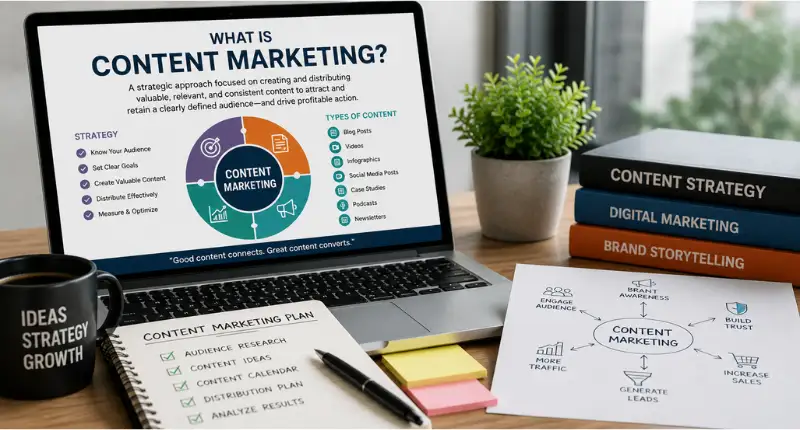
What Is Content Marketing? A Simple Definition
Content marketing is the process of planning, creating, and distributing content that answers a real question your audience is already asking, without pitching your product in the first paragraph. Trust comes first. The sale comes later, sometimes weeks later, sometimes months.
The Content Marketing Institute frames content marketing as a strategic approach built around creating and distributing content that’s genuinely valuable to a clearly defined audience, rather than a sales pitch dressed up as an article. What that definition skips is the part that actually matters for small businesses: it only works if the content is genuinely useful, not disguised advertising with a blog template slapped on top.
I’ve seen this go wrong constantly. A client hands me a “blog post” that’s really just a product page wearing a headline. Google notices. Readers notice faster. And here’s the thing: if your reader can tell you’re selling before you’ve helped, they leave. Every time.
Why Content Marketing Works Better Than Traditional Advertising
Traditional advertising rents attention. Content marketing owns it.
Run a newspaper ad or a paid Google campaign, and the moment your budget hits zero, so does your visibility. I’ve watched this happen to three separate clients in the past two years, all in home improvement, all convinced that pausing ads for a month “to save cash” wouldn’t hurt much. It always hurt. Leads dropped by 60 to 80 percent within a week.
Content marketing doesn’t behave like that. A blog post published in 2023 for a plumbing client of mine is still ranking on page one today, still bringing in five to eight service inquiries a month, at zero additional spend since the day it went live. That’s the difference. Ads are rented space. Content is owned property.
There’s a trust gap traditional advertising can’t close either. Nielsen’s long-running trust research has repeatedly found that people trust recommendations and organic content far more than paid ads, and that hasn’t shifted heading into 2026. People are tired of being sold to. They’re not tired of being helped.
None of this means advertising is useless. It isn’t, and I run paid campaigns for clients every week. But this is what keeps working when the ad budget runs dry, and that’s exactly why it belongs in every strategy, not just the ones with money to burn.
Types of Content Marketing (Blog, Video, Podcast, Infographic, Email)
Content marketing isn’t one format. It’s a toolkit, and picking the wrong tool for your audience wastes months.
Blog Content
Still the backbone of most strategies, and for good reason. A well-optimised post keeps ranking on Google long after you’ve stopped thinking about it. If your goal is search traffic, start here.
Video Content
YouTube is the second-largest search engine on the planet, and short-form video on Instagram and YouTube Shorts drives discovery in a way blog posts simply can’t. Video takes more effort upfront, but it builds trust faster because people see a real person, not just words on a screen.
Podcast Content
Underused by most small businesses, which is exactly why it works. A podcast builds a loyal, repeat audience in a way blogs rarely do, since people listen while driving, cooking, or working out. It takes months to build an audience, so don’t expect fast results here.
Infographic Content
Best for data-heavy topics, or industries where visuals explain things faster than paragraphs can. Real estate and healthcare clients of mine get strong engagement from infographics on Pinterest and LinkedIn specifically.
Email Content
The most underrated of the five. Email doesn’t bring in new audience, but it turns readers into repeat visitors and, eventually, customers. Every blog post I write ends with a subscribe option for exactly this reason.
How to Build a Content Marketing Strategy from Scratch
Most content marketing strategies fail before they start, not because the content is bad, but because there’s no actual plan behind it. Here’s the process I use with every client, condensed into seven steps.
- Define your audience. Not “everyone interested in home improvement.” Specifically, homeowners aged 30 to 55 searching for renovation cost estimates.
- Set goals. Traffic, leads, sales, or brand awareness. Pick one primary goal, because chasing all four at once dilutes everything.
- Choose your content types. Match the format to where your audience actually spends time, not where you feel most comfortable creating.
- Build a content calendar. Consistency beats intensity every time.
- Create and publish. Quality over speed. One genuinely useful post beats five rushed ones.
- Promote it. Publishing isn’t distribution. Share it, email it, link to it internally.
- Measure and optimise. Check what’s ranking, what’s converting, and cut what isn’t.
The result is a system that compounds, instead of a pile of disconnected posts nobody finds.
Content Calendar: How to Plan and Schedule Content Consistently
A content calendar is just a schedule, but it’s the single biggest predictor of whether a strategy survives past month three.
I ask every new client the same question: can you commit to one solid post a week for the next six months? Most say yes in the meeting. Fewer than half actually do it, and the ones who don’t almost always see their traffic plateau by month four.
Keep the calendar simple. A spreadsheet with columns for topic, target keyword, publish date, and status works better than any fancy tool I’ve tried. Plan a month ahead, not a year. Trends shift, and locking yourself into twelve months of pre-planned topics means you’ll be publishing something irrelevant by autumn.
How We Took One Client From Zero Blog Traffic to 30 Leads a Month
In 2023, a home improvement client came to me with a website that had never published a single blog post. Zero organic traffic outside their own business name. We started with one post a week, targeting specific, low-competition local search terms instead of chasing broad keywords like “home renovation.”
The first two months, nothing happened. That’s normal, and I told the client as much upfront, though I’ll admit I was second-guessing our keyword targets myself by week six. By month four, three posts had cracked page one. By month seven, the site was pulling in around 30 qualified leads a month from organic search alone, at zero cost per lead.
What changed wasn’t luck. It was picking specific, answerable questions their customers actually searched for, and publishing consistently even when the early months showed nothing.
How to Measure Content Marketing ROI
Content marketing ROI is calculated as (value generated from content minus content cost), divided by content cost, multiplied by 100.
Here’s a beginner-friendly example. Say you spend ₹15,000 a month on a blogger to write four posts, and after six months those posts generate 20 leads, of which 4 convert into customers worth ₹10,000 each in average order value. That’s ₹40,000 in revenue against ₹90,000 in total content spend over six months, which looks like a loss on paper.
But content compounds. Those same four posts keep ranking in month seven, eight, and beyond, with no additional spend. Run the same calculation over twelve months instead of six, and the ROI usually flips positive, often sharply, because the cost stayed flat while the leads kept coming.
Track three numbers monthly: organic traffic to each post, leads generated per post, and cost per lead compared to your paid channels. If a post isn’t moving any of these after four to six months, it’s worth updating or replacing.
Content Marketing vs SEO: How They Work Together
Content marketing and SEO aren’t competitors. One’s basically useless without the other.
SEO is the technical and strategic work that makes content findable: keyword research, page speed, internal linking, site structure. Content marketing is what actually gets published on top of that foundation. Publish brilliant content on a technically broken site, and nobody finds it. Nail the technical SEO with thin, unhelpful content, and Google eventually catches on and drops the rankings anyway.
Honestly, I’d argue SEO without a real content plan behind it is the more common failure I see, agencies obsessing over meta tags and backlinks while publishing content nobody actually wants to read. Google’s own guidance is explicit about this: content should be created for people first, search engines second. That’s not a suggestion. It’s the ranking system working as designed.
Content Types Compared
| Format | Best For | Cost | Time to Results | Difficulty |
| Blog Posts | Search traffic, SEO | Low to Medium | 3-6 months | Medium |
| Video | Brand trust, engagement | Medium to High | 2-4 months | High |
| Podcast | Loyalty, repeat audience | Low to Medium | 6-12 months | Medium |
| Infographic | Shareability, data topics | Medium | 1-3 months | Medium |
| Retention, repeat sales | Low | Immediate | Low |
Frequently Asked Questions
How is content marketing different from advertising?
Advertising pays for attention directly, and it stops the moment you stop paying. Content marketing earns attention by being useful first, and it keeps working long after publication, often for years, without extra spend.
How long does content marketing take to show results?
Most blog-based strategies need three to six months before meaningful organic traffic shows up. Video and social content can move faster, sometimes within weeks, but it rarely compounds the same way blog content does.
How many blog posts should I publish per week?
One well-researched post a week beats three rushed ones. Consistency matters more than volume. If you can only manage one post every two weeks, that’s fine too, as long as you actually stick to it.
What is the most effective type of content marketing?
Depends entirely on your audience and your goal. For search traffic, blog content usually wins. For trust and engagement, video tends to outperform everything else. There isn’t a single “best” format across every business.
Can small businesses do content marketing on a budget?
Yes, and honestly, tight budgets often force better content decisions. A single well-targeted blog post published consistently beats a scattershot approach across five platforms with no clear plan.
What is a content marketing strategy?
It’s a documented plan covering your target audience, goals, content types, publishing schedule, and how you’ll measure success. Without it, you end up with random posting and no real direction.
Is content marketing better than SEO?
Neither works well alone. SEO makes content findable. Content marketing gives SEO something worth finding. Treating them as separate strategies is one of the most common mistakes I see clients make.
Keep Reading
Content marketing works best alongside a solid technical foundation. We covered the fundamentals in our guide to SEO basics, and if budget is the main concern, our breakdown of SEO for small business covers exactly that. If blogging is your starting point, our guide on how to start a blog on WordPress walks through setup. Pairing content with social distribution matters too, which we cover in social media marketing notes. And for the bigger picture, see our complete guide to what digital marketing actually is.
If you’re building a content marketing strategy and want a second set of eyes on it, Hardik at HV Digital Marketing works with businesses on exactly this. Reach out through the contact page if you’re stuck.

Founder, Digi Segment
SEO Strategist & Digital Marketing Expert
Hardik Vaghani is a digital marketing professional and SEO strategist based in Surat, Gujarat, India. He founded Digi Segment to share practical, experience-backed insights, case studies, and step-by-step guides on SEO, digital marketing, AI tools, and online growth strategies.
With hands-on experience across Search Engine Optimisation, Technical SEO, Google Ads, Meta Ads, and Content Strategy, Hardik has worked with businesses across e-commerce, real estate, healthcare, home improvement, and solar industries to improve organic visibility, local rankings, and lead generation through ethical, white-hat strategies.
He specialises in Core Web Vitals optimisation, on-page SEO, keyword research aligned with search intent, and building scalable content frameworks that rank.
Expertise: SEO | Technical SEO | Google Ads | Meta Ads | LinkedIn Ads | Pinterest Ads | ChatGPT Ads | Content Strategy | Core Web Vitals | WordPress | Digital Marketing | Lead Generation | Local SEO