Do you remember the good old days when marketing was all about putting up billboards and TV commercials? Well, those days are long gone, and honestly, I think it’s for the better. Today, we live in a world where, before you know what you want, your smartphone knows, and with a few clicks, you can reach millions of people. And that’s what digital marketing is all about.
But here’s the thing digital marketing is about more than just putting stuff on social media or sending emails. It’s a total game-changer that can affect any and all businesses, and if you’re not using it in your business, you’re missing out big time. So let’s dive in and learn everything you need to know about digital marketing, because trust me when I say this is something you absolutely need to master in 2026.
What Is Digital Marketing?
Digital Marketing Definition and Core Concept
Alright, so what is digital marketing in simple terms? Well, it is really just marketing that occurs through the internet and/or other electronic devices. Take a moment to consider that the next time you see an ad on Instagram, receive a promotional email, or look for something on Google and see ads come up: that is all digital marketing.
The basic idea here is pretty simple: businesses aim to connect with their future customers where they are already spending their time, namely, online! And, let’s be honest, we’re a digital world nowadays. Whether it’s flipping through TikTok, checking email, looking for information on Google, you name it, digital touches are everywhere these days!
What’s amazing about digital marketing is its ability to track and measure your marketing efforts in real-time. In other words, you can literally see what’s working and what isn’t working and make adjustments on the fly. Try doing that with a billboard, huh?
Why Digital Marketing Is Important in 2026
That’s why digital marketing importance can’t be overemphasized. Your customers are online; it’s as simple as that. Research has proven that people are spending over 6 hours a day on the internet, and that’s just growing! So if you’re not reaching out to customers where they are, be assured that your competition surely will.
Plus, digital marketing ensures that you’re on an equal footing. You don’t need to break your bank to be able to compete. A small business can now reach people all over the world, and you can now be better than a company ten times your size—incredible, huh?
One other huge benefit? Personalization! With digital marketing, you can target a message at a particular group of people depending on their behaviors, preferences, and even demographic information. It sounds like a personal conversation with a prospective buyer, right?
Traditional Marketing vs Digital Marketing
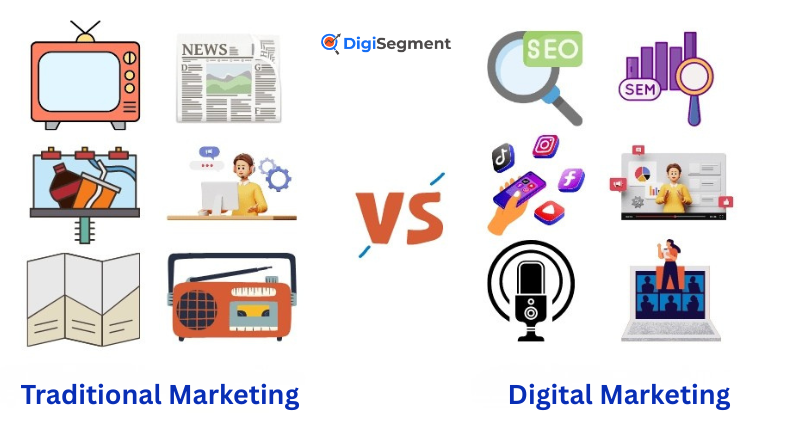
Okay, look, traditional marketing is not to say it doesn’t have its place, but let’s compare the two marketing approaches, and look, traditional marketing is basically print ads, TV commercials, radio ads, direct mail, and stuff like that. Real one-way communication, not really interactive, but mass communicative, if you will.
Digital marketing is interactive, quantified, and budget-friendly. You can monitor all the interactions, views, and conversions. You can interact with your customers in real time through comments and messages. You can also adjust your campaigns based on actual data rather than assumptions.
The biggest difference, though, is ROI. In traditional marketing, you can’t really be sure how many people saw your ad and responded to it. In digital marketing, you can be sure of what’s working and what’s not, and that’s a huge advantage to a business.
The Evolution of Digital Marketing
From Traditional Advertising to Digital Channels
Digital marketing did not begin overnight. It has been developed over the years as technology continues to grow. It all began back in the 1990s when businesses developed websites and used emails.However, the arrival of search engines like Google changed all this by introducing advertising and SEO.
However, the true explosion came when social media was developed. For instance, businesses could access billions of users through social media sites like Facebook, Instagram, and Twitter. For some businesses, you no longer need to make a TV advert to market to millions of users.
How Consumer Behavior Transformed Marketing
Consumers have changed dramatically. Consumers now expect an online experience before purchasing, advertising, and promotions. They expect authenticity rather than pitches, and above all, they have zero tolerance for non-relevant ads.
This change also forced the marketers to change. Digital Marketing is no longer about forcing people to look at ads, it’s about delivering value—good content, entertaining videos, helpful information, etc. It’s no longer about sales, it’s about relationship-building.
The Rise of Mobile-First and AI-Driven Marketing
Today, over half of all web traffic comes from mobile devices. So if you’re not optimizing your marketing for mobile, you’re losing customers. Mobile-first design is no longer optional, it’s required.
And then there is AI. Artificial intelligence is transforming digital marketing with its ability to automate tasks, personalize messages, and make predictions about customers’ behavior. Some tools can quickly sift through vast amounts of data and bring back knowledge that would take a human team weeks to unearth. We’re living in the future, folks.
Digital Marketing Channels
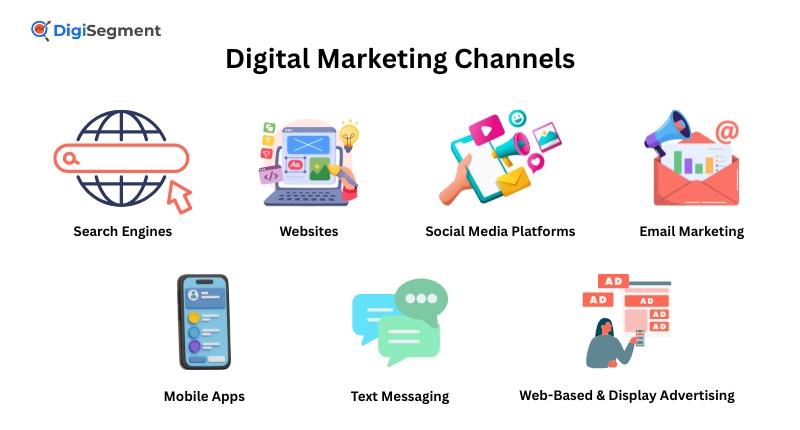
Digital Marketing Channels Explained
Digital marketing channels are basically the means by which we are going to reach out to consumers. Each digital channel has its own strengths. If you are a good digital marketer, you need to learn the various channels and how to effectively utilize them. First, I’ll explain the channels to you.
Search Engines
For instance, search engines like Google and Bing are the platforms where users search for something if they need it. In other words, whether it is “the best pizza near me” or “how to open a business,” users will always find exactly what they need through these search engines.
Therefore, the importance of SEO and paid search ads is that it allows them to be present exactly where users need it.
Websites
Your website is your online headquarters, the place where people want to hear about your business, explore your offerings, and ultimately make a purchase. Creating a good, speedy site is important for gaining visitors’ trust and holding their interest.
And for even more information on creating an efficient digital strategy, head on over to Digi Segment!
Social Media Platforms
Facebook, Instagram, LinkedIn, and TikTok—these are the platforms where the conversations actually take place. Social media allows you to build communities, engage with customers, and express the personality of your brand.
And don’t forget how well it works to target specific demographics with paid advertising.
Email Marketing
In fact, email marketing is far from dead, especially considering that it one of the biggest ROI generators in the realm of digital marketing. Well-executed email marketing campaigns can result in successful lead nurturing, client loyalty, and revenue growth.
Moreover, an email list is under the marketer’s control, unlike followers on social media networks that are largely at the mercy of the algorithms used by these networks.
Mobile Apps
You have a direct connection to customers through mobile applications. Push notifications, in-app messages, and a tailored experience all keep them coming back. If your business can benefit from an app, then it is worth doing.
Text Messaging (SMS & WhatsApp)
SMS and WhatsApp marketing have ridiculously high open rates: 90% or above. It’s a great way to send promo messages, remind people about an appointment, or offer customer support. Just be careful not to abuse it; nobody likes spam.
Web-Based & Display Advertising
Display ads are those banners that pop up on websites and apps. They work well for brand awareness and reaching people who have visited your website before. When you pair them with good targeting, display ads can be very powerful.
Digital Marketing for Business Models
B2B Digital Marketing
B2B (business to business) digital marketing is used for targeting businesses rather than individuals. B2B digital marketing is all about building business relationships, showcasing your expertise, and providing value-added content through long-form content and webinars. Patience is essential in B2B digital marketing.
B2C Digital Marketing
B2C (business to consumer) marketing is more focused on individual customers. It is more emotive and image-focused with a stronger emphasis on conversion speed. Think about catchy ads or influencer deals with flash sales.
Difference Between B2B and B2C Digital Marketing
Differences between B2B digital marketing and B2C digital marketing are very profound. In digital marketing for B2B, there are multiple stakeholders involved, and decisions can take years to be made, unlike the case with digital marketing for B2C, where the decision-making process is much faster and freer from red tape.
B2B Messaging is business-like, data-based, and ultimately ROI-oriented, while B2C Messaging tends to be informal, emotional, and lifestyle-based. B2B Buyers need logic, data, and proof, whereas B2C Buyers are driven by emotion, need, and impulse. Understanding your audience is a key component of knowing how to talk to them!
Benefits of Digital Marketing
So what’s the big deal with digital marketing? Well, it’s because the advantages are enormous, and they’re applicable to every business, big and small.
Reach a Global Audience
No geographical constraint exists in digital marketing. You can reach your clients across the globe without having physical outlets. Your small business in India can sell products to clients in the US, Europe, and anywhere in the world where internet access exists.
Cost-Effective Marketing
In fact, digital marketing is much cheaper than traditional marketing. You can run a campaign on social media, send messages via email, and even optimize your website for a fraction of the cost of a single commercial on TV! And the returns are much higher, too!
Measurable and Trackable Results
Every click, every view, every conversion is tracked. Know exactly what works and what doesn’t, and adjust your campaigns in real-time accordingly. You can’t get that kind of transparency with any form of traditional marketing.
Personalization and Customer Targeting
Digital marketing also enables you to target your customers and personalize your message according to their behavior, preferences, and demographics. In return, it makes your marketing more relevant and responsive to each customer’s needs.
Easy and Faster Conversions
Today, customers can potentially go from seeing an advertisement to becoming a paying customer within seconds. This is because one-click purchases, as well as other aspects of digital marketing, are now faster and easier than they’ve ever been.
If you’re looking for a digital marketing firm that can provide you with these benefits, HV Digital Marketing can offer you a customized strategy that produces results.
Core Types of Digital Marketing
Owned Media
Media that you own, such as your website, social media, email list, and blog, are referred to as owned media. Content marketing can be defined as the content on your blog, videos, podcasts, and infographics that attract your target audience.
Search Engine Optimization
Another area under the owned media category is “Search Engine Optimization.” This is the process “of optimizing your website to rank better in search results through on page optimization, link building, and other techniques.”
Paid Media
It’s where you pay to reach out to people. Paid media includes Search Engine Marketing or Pay-Per-Click advertising and affiliate marketing. These are fast, efficient, and powerful means of advertising that suit businesses that need immediate results.
Earned Media
Your earned media is the publicity you receive through word of mouth and customer reviews. Social media marketing and native advertising are all included in earned media marketing. This type of advertising is said to be the most credible form of marketing since it does not come directly from you.
Digital Marketing Strategy Development
Define Your Digital Marketing Goals
Begin by establishing clear goals with the SMART criteria of Specific, Measurable, Achievable, Relevant, and Time-bound. For example, “Increasing website traffic by 30% within three months” would be a SMART goal. “Increasing visitors” would not be.
Identify and Understand Your Target Audience
Develop specific buyer personas that represent your perfect customers. Understanding the journey a customer takes from awareness to purchase is also vital. This will enable you to relate to them accordingly throughout the journey.
Budget Planning and Channel Selection
Pick channels that match your goals and where your audience spends their time too. Also, don’t be everywhere at once and try to master a few channels at a time.
Creating Cohesive Multi-Channel Campaign
The most effective digital marketing campaigns are those that use a combination of many channels. Your social media campaigns should complement your email marketing campaigns. Your content should drive traffic to your landing pages.
Measuring Digital Marketing Success
Key Performance Indicators (KPIs)
Track the metrics that are aligned with your goals, such as traffic, engagement, conversion, and revenue metrics. You can use analytics tools to track all this.
ROI Calculation
ROI (return on investment) – whether or not your marketing effort was profitable – can be determined by dividing your net profit by your total marketing cost and changing it to a percentage by multiplying by 100.
A/B Testing and Optimization
A/B testing means making two variants of something, such as an email, ad, or website, then comparing which version performs better. It’s the scientific way to get better at your marketing over time.
Challenges in Digital Marketing
There’s no sugarcoating that digital marketing isn’t all sunshine and rainbows, either, having your organic traffic crash to zero because of an algorithm change, and data privacy regulations making customer data collection much harder with the likes of GDPR, etc., etc.
Competition is very high, so cutting through the conversations gets harder. Just focus on making valuable content and building real relationships. Lastly, ROI measurement can be very complex, especially when your customers are touching different touchpoints, but proper analytics tools are used.
Digital Marketing Trends for the Future
AI plays an important role in the digital marketing field. For instance, AI helps in hyper-personalization and predictive analytics. With voice search optimization, smart speakers are on the rise. Interactive content, like quizzes, allows for engagement with the audience in ways that normal content cannot.
Consumers demand personal experiences, and today’s technology makes it possible to deliver those experiences at scale. As concern about privacy continues to escalate, ethical marketing will be a competitive differentiator.
Conclusion: What Is Digital Marketing and Why It Matters
So there you have it, digital marketing in a nutshell. It is not just another buzzword or passing trend. It is the future of the way businesses will correspond with customers, and it is available to all who are willing to learn.
“Whether you’re a small business owner or an employee of a multinational corporation, digital marketing puts you in the position to reach the right people at the right time with the right message. And as we all know, having the right message at the right time is literally everything in an attention-based economy.”
The good news? It doesn’t require you to become an expert at everything right away. Just pick a few channels and start with those. Have fun with it, and learn from your successes and failures. Digital marketing is a journey.
Now it’s your turn! Take what you learned here and go out and use it! Your customers are waiting, and the opportunities are endless! So go out there and become a master of digital marketing so that your business prospers!
For even more resources and expert advice on your digital marketing quest, you can visit Digi Segment, where you will find the best guides, case studies, and strategies to help you on your journey.
Frequently Asked Questions About Digital Marketing
Digital marketing is defined as the promotion of a product or service using internet and electronic devices, ranging from social media posts to advertisements on Google and via emails.
Costs can range from hundreds of dollars per month up to millions of dollars, depending upon what you want to accomplish and how you choose to do it. The great thing is it can scale.
Well, it depends on the channel, really. Paid ads can get you traffic almost overnight, SEO takes 3-6 months, and social and content are somewhere in the middle, I guess.
A website is extremely helpful because it is the core of your online presence, but you can start with social media and email marketing if having a website is not immediately feasible.
Absolutely! There are tons of free resources and tools to learn digital marketing. Of course, it does take time and effort, but it’s completely doable. Alternatively, you could team up with experts who already have all the answers.

I’m Hardik Vaghani, founder of HV Digital Marketing, a results-driven digital marketing agency. I specialise in SEO, Google Ads, and social media marketing, helping businesses grow their online presence with proven strategies. I’m passionate about creating high-quality, SEO-optimised blogs that educate readers and rank on Google. My goal is to turn ideas into measurable digital success through smart, ethical marketing.